
Part of The Folder’s After You Sign series — see them all →
Keeping It Current
Estate Plan Maintenance: Why This Is Never Really "Done"
Signing your documents is a moment. Keeping them accurate is a habit. Almost everything worth doing after you sign — funding a trust, checking a beneficiary, giving someone a key — is something you do once. But "once" is doing a lot of work in that sentence, because life doesn't hold still long enough for any of it to stay accurate forever.
Good to know
Questions, answered.
Is there a real difference between a "legal review" and a "practical review"?
Yes, and the distinction matters more than it sounds like it should. A legal review is about your actual documents — it needs your attorney, and it happens when something specific has changed. A practical review is lighter: a regular check that the information about your plan is still accurate, whether or not anything legal needs to change. It doesn't need a lawyer to run, and its entire purpose is catching small things before they quietly become real problems.
What life events mean I need an actual legal review?
Some changes are worth a real conversation with your attorney, not just an update to your own notes. None of these require starting over — most are a conversation and a targeted amendment.
- Marriage, divorce, or a new partner
- A new child or grandchild
- Buying or selling a home
- Moving to a different state
- A significant change in assets, income, or a business
- The death, incapacity, or falling-out with someone named in your plan
What does a practical, annual review actually involve?
A shorter list than it sounds like, and none of it requires a law degree.
- Are your beneficiaries — on retirement accounts, life insurance, everything that passes outside your will — still who you'd actually choose today?
- Is anything you've acquired recently (a new account, a property, a business interest) properly titled and funded?
- Does your personal representative still have a working key, and does their access still make sense?
- Have you opened anything new digitally — a password manager, a crypto exchange, a social account — that isn't reflected anywhere your family could find it?
- Are your attorney's and advisors' contact details still current?
- Has anyone named in your plan moved, changed their number, or had a change in circumstances worth knowing about?
How often should each of these actually happen?
The practical review works best as a yearly habit — treat it like renewing insurance, a fixed date rather than something you get to eventually. The legal review doesn't run on a schedule at all; it happens whenever one of the events above actually occurs, whether that's two months after your last review or five years.
How does The Folder fit into this?
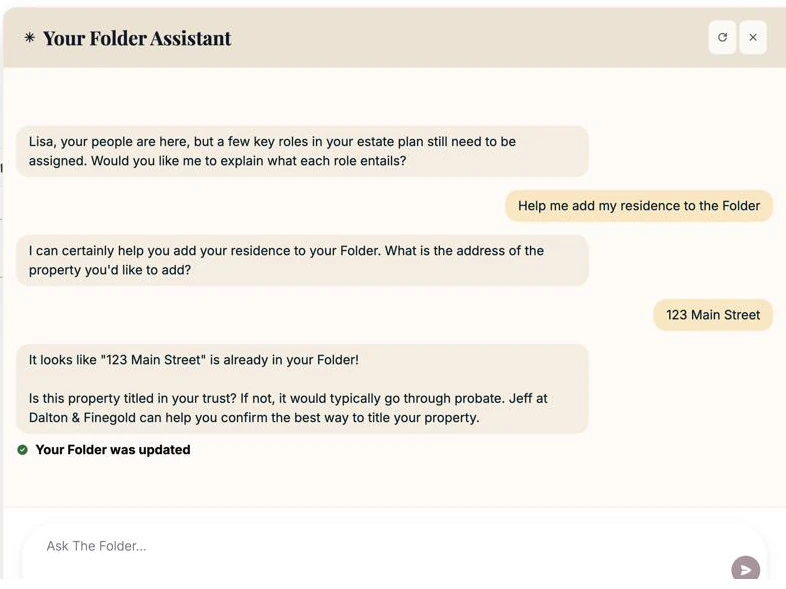
This works one of two ways, depending on your situation. If your attorney's firm partners with The Folder, they send you the annual review directly — a set of questions with no wrong answers, just an honest snapshot of where things stand today. You complete it; your firm reviews your answers and decides whether anything actually needs updating. If there's no firm connection set up, that's fine too — the practical review becomes self-directed instead: once a year, work back through this series of articles, note what's actually changed in your own life and accounts, and bring that list to your attorney yourself. Either way, there's a real financial reason to take this seriously: showing up to your attorney with a clear, already-organized list of what's changed costs meaningfully less than paying them to reconstruct it from scratch during the appointment.
So what's actually the point of all this?
Your estate plan isn't a document you finish. It's closer to something you maintain, the same way a home or a relationship needs upkeep even after the big decisions are made. Life changes, and your plan needs to change with it — that's not a flaw in the process, it's the entire reason a practical review exists: to catch your plan up with your life on a predictable schedule, instead of everyone finding out what's out of date during an actual crisis.
Back to the full After You Sign series →Quick checklist
- Beneficiaries reviewed across every account and policy
- Newly acquired assets checked for proper titling and funding
- Personal representative's access confirmed still current and correct
- New digital accounts (password manager, crypto, social) added to The Folder
- Attorney and advisor contact information confirmed current
- Annual review completed — through your firm's questions, or self-directed through this series
- Changes documented before contacting your attorney, to make the best use of their time
- Annual review date set as a standing habit, not a someday task
“Every page before this one describes something to set up. This is the one that keeps all of them true.”
Start today
Life changes.
Your plan should too.
Start with the plan you already have. The Folder helps you understand it, keep it current, and make sure your family knows what they’ll need when the time comes.
Free for 30 days
No credit card required.
Then $349/year, less than $1 a day. Billed annually.
✓ Everything in The Folder, included
✓ SOC 2 · bank-level encryption
✓ Invite the people you trust
Have a code from your firm?
Encrypted · never sold · you control access